Tips & Guides
Classic Sudoku Rules: Rows, Columns and Boxes
Learn the three Classic Sudoku rules, what counts as a valid move, and how to check a number with a worked grid and beginner practice.
Explore the guide
The three constraints apply togetherA legal candidate is not yet a proven answerThree ways a plausible move goes wrongTry the rule check yourselfClassic rules versus Killer rulesClassic Sudoku uses a 9 × 9 grid divided into nine 3 × 3 boxes. Fill every empty cell with 1–9 so that each row, column and box contains each digit exactly once. Keep the starting clues unchanged.
The three constraints apply together
- A row runs left to right: use each digit once.
- A column runs top to bottom: use each digit once.
- A box is one of the nine thick-bordered 3 × 3 regions: use each digit once.
Diagonals do not have an extra rule in Classic Sudoku. The same digit can occur in separate regions; in a completed grid it occurs nine times overall. Arithmetic is not needed: the digits act as nine distinct symbols.
A legal candidate is not yet a proven answer
A digit that does not currently repeat in the row, column or box is a candidate. It may still be wrong in the completed puzzle. A logical move needs a reason that rules out every alternative for a cell, or every other location for a digit in one region.
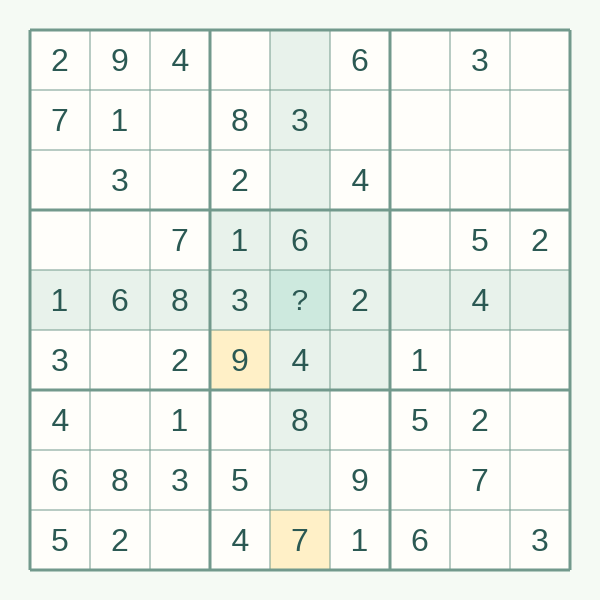
In this example, row 5 is missing 5, 7 and 9. Column 5 contains 7, and the central box contains 9. The intersection r5c5 therefore has only 5 available. This is a naked single; it is stronger evidence than merely finding a digit that does not repeat.
Three ways a plausible move goes wrong
- Checking the row but overlooking a duplicate in the box.
- Choosing one of two candidates without a deduction.
- Counting empty cells as the difficulty rating. The techniques needed to solve a puzzle matter; clue count alone does not establish difficulty.
Try the rule check yourself
After entering 5 at r5c5 in the teaching grid, r5c9 still allows 7 and 9. The column and box do not decide between them. Leaving it blank is the justified decision.
Why not simply try 7?
It is a possibility, but this check has not proved it. Record 7 and 9 as notes and scan another region. The beginner walkthrough shows the full elimination.
Classic rules versus Killer rules
Killer Sudoku retains all three constraints and adds non-repeating cages with totals. Do not apply cage arithmetic or a diagonal restriction to a Classic puzzle unless that variant explicitly introduces it.
Play Classic Sudoku →Choose Easy when you start a new puzzle. Opening the game does not replace an existing round.
Read next
How to Play Sudoku: A Beginner’s GuideSudoku Notes: Find and Update Candidate NumbersNaked Singles in Sudoku: One Cell, One CandidateKiller Sudoku Rules: Cages, Totals and No RepeatsAbout the examples
Written with AI assistance for Zen Sudoku. Classic candidate deductions and cage arithmetic are checked by automated validation. Figures are teaching examples; incomplete cage fragments are labelled. Language wording awaits editorial review.
Rules reference: Sudoku.com