Tips & Guides
Naked Singles in Sudoku: One Cell, One Candidate
Identify a naked single by checking a cell’s row, column and box. Follow a worked elimination and learn when two candidates are not enough.
Explore the guide
Look at a cell, not just a missing row digitWorked example: r5c5 must be 5Naked single versus hidden singleCounterexample: do not force the next cellRepeat the scan after each placementA naked single is an empty Sudoku cell with exactly one candidate remaining after all applicable constraints are checked. That digit must occupy the cell. The cell’s row does not have to be almost full.
Look at a cell, not just a missing row digit
Take 1–9 and eliminate digits already in the row, column and box. If exactly one remains, you have a naked single. If two remain, neither is proved. The candidate-notes guide explains how to keep that set accurate.
Worked example: r5c5 must be 5
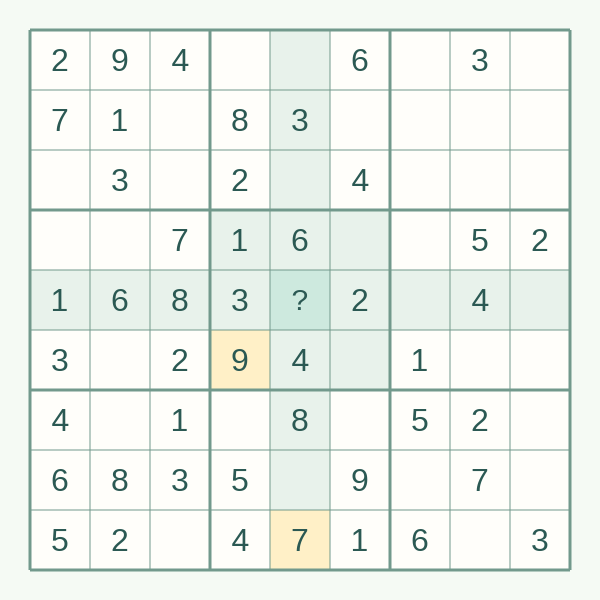
- Row 5 contains 1, 2, 3, 4, 6 and 8. Begin with {5, 7, 9}.
- Column 5 contains 7 at r9c5. Remove 7.
- The central box contains 9 at r6c4. Remove 9.
- Only 5 remains for r5c5. Enter 5.
Each elimination has a specific source on the board. A single clue from the row would not have been enough; all three kinds of region work together. This uses the ordinary Classic constraints, not a guessing rule.
Naked single versus hidden single
A naked single asks, “What is the only digit this cell can take?” A hidden single asks, “Where is the only place this digit can go in this region?” A cell with several candidates can still contain a hidden single, so the two scans complement each other.
Counterexample: do not force the next cell
After placing the 5, r5c9 still has candidates {7, 9}. Check its column and box again before deciding.
Is r5c9 now another naked single?
No. Neither region rules out 7 or 9. Keep both as notes and look elsewhere. Recognising an unresolved cell is part of correct solving.
Repeat the scan after each placement
A confirmed digit can reduce several nearby candidate sets. Review its row, column and box, then move to another area if none becomes a single. Do not assume that every puzzle can be solved with naked singles alone; later positions may require different techniques.
For a complete first-game sequence, return to how to play Sudoku. For extra sum constraints, compare the Killer rules.
Find a single on the board →The example is static; opening the game keeps your existing round.
Read next
Hidden Singles in Sudoku: One Digit, One LocationSudoku Notes: Find and Update Candidate NumbersHow to Play Sudoku: A Beginner’s GuideAbout the examples
Written with AI assistance for Zen Sudoku. Classic candidate deductions and cage arithmetic are checked by automated validation. Figures are teaching examples; incomplete cage fragments are labelled. Language wording awaits editorial review.