Tips & Guides
Killer Sudoku Combinations: From Cage Sums to Placements
List distinct-digit Killer Sudoku cage combinations, eliminate impossible sets, and learn why a unique combination still needs an order.
Explore the guide
List sets without repeats or duplicate ordersWorked fragment: total 10, then determine the orderA candidate must fit every applicable constraintPractice: three cells totaling 6A repeatable solving loopA Killer Sudoku cage combination is a set of different digits whose sum equals the cage total. It tells you which digits could be used together, not where each one goes. Placements must also obey the row, column, box and cage rules.
List sets without repeats or duplicate orders
For a two-cell cage totaling 10, the possible sets are {1, 9}, {2, 8}, {3, 7} and {4, 6}. The pair {5, 5} repeats a digit and is forbidden. The pair {9, 1} is the same combination as {1, 9}, although its placement order differs.
| Cells | Total | Distinct-digit combinations |
|---|---|---|
| 2 | 3 | {1, 2} |
| 2 | 4 | {1, 3} |
| 2 | 10 | {1, 9}; {2, 8}; {3, 7}; {4, 6} |
| 2 | 16 | {7, 9} |
| 3 | 6 | {1, 2, 3} |
These rows list distinct-digit sets. They do not guarantee every set will fit a particular position. Read the Killer rules before using the table as a shortcut.
Worked fragment: total 10, then determine the order
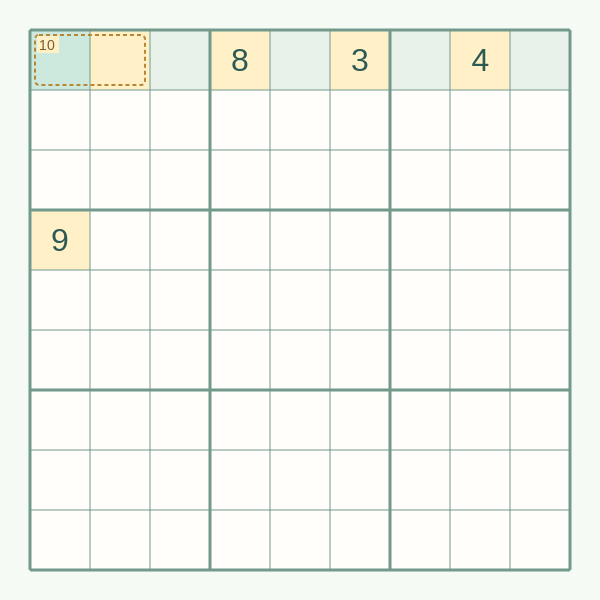
- The two highlighted cells r1c1 and r1c2 total 10.
- Their shared row already contains 8, 3 and 4. Neither cage cell can use those digits. Remove {2, 8}, {3, 7} and {4, 6}.
- Only {1, 9} remains, but either order still satisfies the total.
- Column 1 already contains 9 at r4c1. Therefore r1c1 is 1 and r1c2 is 9.
This fragment illustrates one deduction, not a complete puzzle with a claimed unique solution. The key distinction is between reducing a cage’s digit set and proving the value of an individual cell.
A candidate must fit every applicable constraint
If a cage crosses boxes, a digit placed in one cell still affects that cell’s own box. Within the entire cage, the digit cannot repeat even in cells that share no row or box. Use candidate notes to combine these restrictions rather than applying the sum in isolation.
The 45 rule adds another source of totals, but only when the counted cells and cage boundaries match the region you are subtracting from.
Practice: three cells totaling 6
Which distinct-digit set can fill a three-cell cage totaling 6? Does knowing the set establish its order?
Show the answer
The only set is {1, 2, 3}. Repeated-digit alternatives are not allowed. Several orders may still fit, so use the surrounding regions before entering individual digits.
A repeatable solving loop
Count the cage cells, list possible sets, remove sets contradicted by known digits, compare positions, then confirm a cell only when justified. After a placement, check all affected cages and regions again.
Practise a small cage →Start with an Easy Killer puzzle when opening a new round.
Read next
Killer Sudoku Rules: Cages, Totals and No RepeatsSudoku Notes: Find and Update Candidate NumbersHidden Singles in Sudoku: One Digit, One LocationAbout the examples
Written with AI assistance for Zen Sudoku. Classic candidate deductions and cage arithmetic are checked by automated validation. Figures are teaching examples; incomplete cage fragments are labelled. Language wording awaits editorial review.
Rules reference: Sudoku.com